New Tax Planning Opportunities Under the OBBBA
On July 4th, 2025, the One Big Beautiful Bill Act (OBBBA) was signed into law, making permanent the tax cuts introduced by the Tax Cuts & Jobs Act of 2017 (TCJA). Thankfully, this bill was passed mid-way through 2025, so we have ample time to plan for how this will impact your 2025 taxes. Coincidentally, this aligns with our fall tax planning timeline for our clients. Below, I'll highlight some of the notes and takeaways I have from my initial research on the bill, but before that, please use the link below to send us your 2024 tax return, a recent pay stub, and answer the questions about your 2025 tax plans so we can start the tax planning process.
One Big Beautiful Link to Submit Your Tax Return
This isn't meant to be an exhaustive review of an 870-page bill, nor is it meant to be a political commentary in either direction. Rather, based on my initial research, there are a few interesting planning opportunities that will impact clients, and I'd like to briefly discuss those.
Last caveat: Many of these items are still up in the air on how the IRS will interpret them or how guidance will be issued.
Last last caveat: since I'm not a tax attorney or CPA, I'll always defer to these experts for specific tax advice, and I'm focused on general planning opportunities.
Now, more than ever, it's important to engage in proactive tax planning, and I believe that's one of the true differentiators we provide to our clients. Many of these provisions include phaseouts or "tax torpedos," as I've heard them called, where a wrong decision can cost you dearly. We would love to work with you and your tax preparer, if you have one, to coordinate strategies, potentially avoid pitfalls, and ensure you're pursuing every opportunity these changes allow.
Bracket Sizes & Standard Deduction
The 10% and 12% brackets are expanding due to an additional inflation adjustment.
These effects are marginal if you're solidly in the 22% bracket and above, but with the larger Standard Deduction introduced by the TCJA and now the enhanced senior deduction (mentioned below), a married couple filing jointly (MFJ) making up to $130,000 in gross income can be eligible for a 0% capital gains tax rate (which is tied to the 12% bracket)
Long-term, this could reduce the attractiveness of retirement-type accounts for people projected to be in lower tax brackets in retirement.
The Standard Deduction is also getting an increase of $1500
Charitable Giving
For Non-Itemizers (almost 90% of taxpayers)
Starting in 2026, if you give $2,000 or less to charity, you will be eligible to add up to $2,000 (if married filing jointly)/$1,000 (for single filers) to your deduction for qualified charitable contributions, even if you're not itemizing.
Planning opportunity: If you usually give less than $2,000 to charity and you take the standard deduction, it could make sense to hold off on that gift until January 1st, 2026, to maximize this deduction for next year.
Note: Please retain your receipts for charitable gifts made during the year, such as those to Goodwill or other organizations, as this is an easy way to reduce your taxable income starting next year.
For Itemizers
Starting in 2026, there is a hurdle of 0.5% of Adjusted Gross Income (AGI) for charitable deductions. This hurdle reduces your deductible amount.
Example: A married couple earns $250,000; they tithe 10% of their income ($25,000) and are itemizing this year. Their charitable deduction is $25,000-(0.5% x $250,000)=$23,750.
Planning Opportunities
Gift Lumping (giving multiple years of donations in one calendar year) could still make sense to avoid losing that 0.5% of AGI Floor each year.
We can utilize Donor Advised Funds for this accelerated giving if you'd like to realize the tax benefits while not officially gifting the money in that year.
2025 Gift Lumping: The AGI floor doesn't kick in until next year, so it could make sense to pre-give for 2025 if you have the capital lying around.
Qualified Charitable Distributions (QCDs) are not subject to the 0.5% AGI Floor, so these, as always, are great tools for our clients who are over 70.5
37%ers only get a 35% deduction. For those who fall in the prestigious 37% tax bracket, the OBBBA caps charitable deductions at $0.35 per every dollar of income. So it actually costs these folks an extra 2% to give to charity.
SALT Deduction Cap Increase
From 2026 to 2029, there is an increase in the state and local tax deduction (SALT) from $10,000 to $40,000.
This could change the number of people eligible for itemization in the future.
This starts to phase out for taxpayers earning over $500,000 in AGI next year.
New Deductions
Enhanced Senior Deduction
In effect from 2025 to 2028
$6,000 Single/$12,000 married filing jointly for taxpayers over 65
Starts to phase out at $75k Single/$150k Joint
No Tax on Tips
In effect from 2025 to 2028
Up to $25,000 for all filing statuses
Tip income will not be subject to federal income tax, but will still be subject to payroll tax.
Starts phasing out at $150k single/$300k married filing jointly
No Tax on Overtime
In effect from 2025 to 2028
Up to $12,500 Single/$25,000married filing jointly
Just the overtime is not taxed. For example, if you make time and a half with a base rate of $50 per hour, only the $25 per hour in overtime wages is eligible for this deduction calculation.
This phase-out is at the same level as tip income
Deductible Interest on Auto Loans
In effect from 2025 to 2028
Up to $10,000 deduction for new loans taken after 12/31/2024
Phases out at $100,000 AGI for single and $200,000 for married filing jointly
We still prefer our clients to pay cash for cars
Notes
Only eligible for cars assembled in the US. You're already starting to see this advertised on commercials, but be sure to check.
Only the interest is deductible.
The math isn't great from a planning perspective. Let's say you take out a $40,000 car loan at 6% interest. In the first year, you'll pay $2,400 in interest. That interest is deductible, so at a 22% tax rate, you'd save $528 in taxes. In other words, you pay $2,400 to the bank and get $528 back at tax time.
Most car loans last about 67 months (over 5 years), but this deduction only applies from 2025 to 2028. That means unless you pay the loan off early, you'll likely still be paying interest after the tax benefit ends.
In sum, if you were already planning to take out a car loan in 2025, you'll get a very, very slight tax deduction if you're under the income limit. I wouldn't go looking for a car payment, though.
Trump Accounts
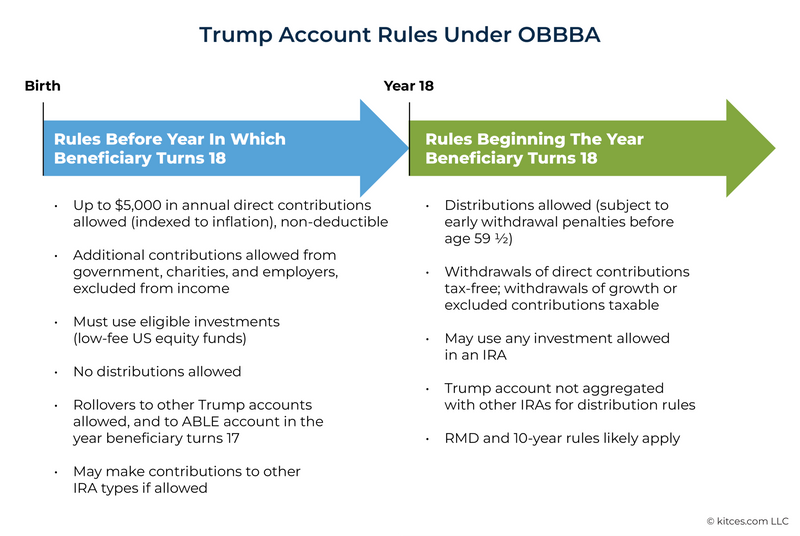
Starting in 2026, up to $5,000 per year can be added to a "Trump Account" (I'm sure it'll get called something else… actually, I'm not that sure) for beneficiaries under the age of 18.
This is intended to be a kickstart for retirement savings for children, even if they don't have earned income. It will be able to be invested in low-cost investments that track indexes, such as the S&P 500.
Potential $1,000 credit available. I won't speculate on this until we receive more information.
Please refer to the graphic below for more information. I'm certain more clarity will emerge about these vehicles before they start, one year after the bill was signed (July 4, 2026).
Expanded 529 Expenses for K-12 education
Cap increased from $ 10,000 to $ 20,000 per year.
Can be used for textbooks, curriculum materials, instruction materials, and online education materials.
This is great for those who choose to homeschool or are enrolled in private schools that have additional expenses associated with tuition.
Tutoring (if the tutor is not a relative and meets certain qualifications).
Fees for standardized tests.
Dual enrollment fees (for high school students taking college courses).
Post-secondary credential expenses: exam fees, tuition, books, and continuing education.
As you can see, there's a lot to consider when it comes to tax planning, especially during this unique window from 2025 to 2028, while these additional deductions are available. We're here as a resource for you and anyone you care about who has questions about how these changes could impact their financial plan.
Rob Clark, CFP®, is a CERTIFIED FINANCIAL PLANNER® professional at INT Wealth Planning, serving upper-income professionals in the Greater St. Louis area. Rob specializes in simplifying complex financial decisions and creating tailored strategies for wealth accumulation and retirement planning. INT Wealth Planning focuses on helping clients get organized, make informed financial decisions, plan for retirement, and pursue financial confidence. Rob can be reached at (636) 777-4207, via email at rob@intwealthplanning.com, or online at www.intwealthplanning.com.
This material has been edited with the assistance of artificial intelligence tools. The information presented is based on sources believed to be reliable and accurate at the time of publication. This material is for educational purposes only and does not necessarily reflect the views of the author, presenter, or affiliated organizations. It should not be construed as investment, tax, legal, or other professional advice. Always consult a qualified professional regarding your specific situation before making any decisions.
Tracking# 779582