The Secret to Better Golf and Better Financial Decisions
Golf is the most fulfilling and frustrating game out there. There are games within the game: you vs. the course, you vs. your mind, you vs. the elements, and you vs. your swing.
At its core, it's a very simple game. Start far away and get the little white ball into the little white cup in as few strokes as possible.
When a golf course is designed, each hole has a "par," which is the number of strokes it's expected to take to complete the hole. Most holes are par 4s, meaning four strokes from the tee box to the hole. Most courses have a total par of 72.
In golf, there are different names for each score on a hole. A hole-in-one is very rare, but it's also called an "ace." If you're three under par on a hole (even more rare), that's an albatross. Two under is an eagle, one under is a birdie, one over par is a bogey, and two over par is a double bogey. After that...people usually just say the number or stop counting altogether. Except for an 8, which is called a "snowman."
When I first started golfing, I was terrible (as most people are). As a recovering baseball player, I had the fundamentals of a swing, but no touch. I would swing about as hard as I could, and the ball would spray all over the place.
I was probably scoring in the 120s when I first picked up golf, and that included plenty of lost balls along the way.
As I started playing more, 120 turned into 110, and eventually I could break 100 consistently. I got some new clubs, kept practicing, started playing a little more, and finally broke 90, getting into what golfers affectionately call "bogey golf." This means, on average, you're making bogey on most holes, usually with a few pars and a few...bigger numbers mixed in.
Eventually, I set my sights on breaking 80. As you'll see in the table below, this is a big deal for a casual golfer.
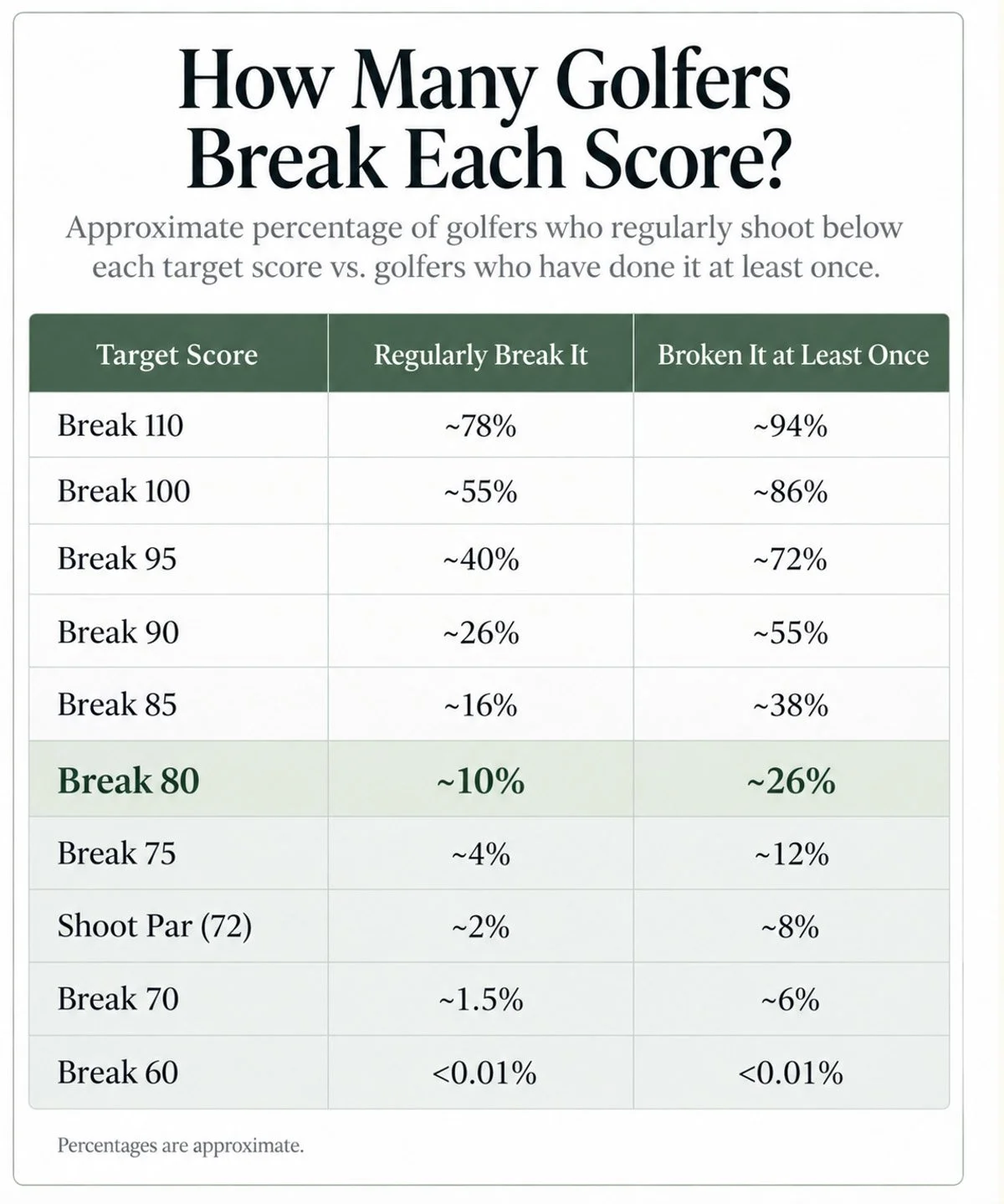
I would often get close, but consistently I was shooting 84, 82, 86, 88, 83...and I couldn't break through.
I started looking more closely at my scores and reading up on what it takes to break 80. What I found was very interesting.
You'd think getting your score lower would be about making more birdies. But it's actually more about making fewer double bogeys or worse. The average golfer who breaks 80 makes just 0.8 birdies per round!
The "formula" for breaking 80 is basically this: No big numbers!
Now, that was a long introduction to tie my golf history into financial planning.
Most people think building wealth is about making more birdies. In reality, it's often more about avoiding the big numbers on each hole.
If you look at Ramsey Solutions' study on millionaires, 79% didn't inherit any money, and only 31% averaged over $100,000 per year over the course of their careers.
The lesson? Building wealth isn't necessarily about hitting home runs (or making birdies). Consistency matters, and so does avoiding the big mistakes that can set you back.
One mistake I see all the time is compounding mistakes, where one bad financial decision leads to another.
For example, let's say I spent too much on vacation, so I dip into my emergency fund to pay off the credit card bill. Next, my car has a problem. Since I've depleted my emergency fund and don't have the money to pay for repairs, I decide to buy a new car and take on monthly payments. To afford those payments, I need to reduce the amount I'm investing each month until the car gets paid off.
One mistake has now turned into several, and something as simple as overspending on vacation has affected my ability to build wealth.
There's a term in golf called "taking your medicine." It's one of the most humbling things you can do on the golf course, but it's crucial for breaking 80.
If I hit my first shot into the trees on a par 4, most of the time there's a "window" where I could try to hit the ball toward the green and save par.
I think the most dangerous words in golf are "I think I can hit it through there."
It's always ironic to me (as a guy who makes this mistake often) that I've just proved, with the shot that got me into the trees, that I'm not good enough to control the ball. Yet somehow, I think I'm going to thread my next shot through the leaves, limbs, branches, and everything else in the way to save the hole.
The best thing to do is usually to punch out of the trees, get back into position, and try to save bogey.
The same idea applies to financial planning. Sometimes the best decision isn't the one that gets you ahead the fastest. It's the one that keeps a setback from turning into something much worse.
For younger clients, financial "double bogeys" often involve taking out loans, pausing investments, or even pulling money from retirement accounts to pay off short-term debts.
For retired clients, they might involve failing to plan for larger expenses, creating unnecessary taxes through poorly timed withdrawals, or taking on more investment risk than their financial situation calls for.
In both cases, the goal isn't to avoid every mistake. That's about as realistic as expecting to play an entire round of golf without a bad shot.
It's about knowing when to take your medicine, make the smart play, and put yourself in a better position for the next hole. Because whether you're trying to break 80 or build lasting wealth, avoiding the big mistakes can matter just as much as making the great shots.
Rob Clark, CFP®, is a CERTIFIED FINANCIAL PLANNER® professional at INT Wealth Planning, serving upper-income professionals in the Greater St. Louis area. Rob specializes in simplifying complex financial decisions and creating tailored strategies for wealth accumulation and retirement planning. INT Wealth Planning focuses on helping clients get organized, make informed financial decisions, plan for retirement, and pursue financial confidence. Rob can be reached at (636) 777-4207, via email at rob@intwealthplanning.com, or online at www.intwealthplanning.com.
This material has been prepared in collaboration with Crystal Marketing Solutions, LLC, and has been edited with the assistance of artificial intelligence tools. The information presented is based on sources believed to be reliable and accurate at the time of publication. This material is for educational purposes only and does not necessarily reflect the views of the author, presenter, or affiliated organizations. It should not be construed as investment, tax, legal, or other professional advice. Always consult a qualified professional regarding your specific situation before making any decisions.
Tracking # 1199087